
Voice Biometrics: How Voice Recognition Technology Knows Who Is Speaking
Voice biometrics recognizes who is speaking, not what they say. Banks, tax offices and call centers use it to confirm callers in seconds. AI voice clones have now put it at the center of a fierce debate about trust.
What is voice recognition technology?
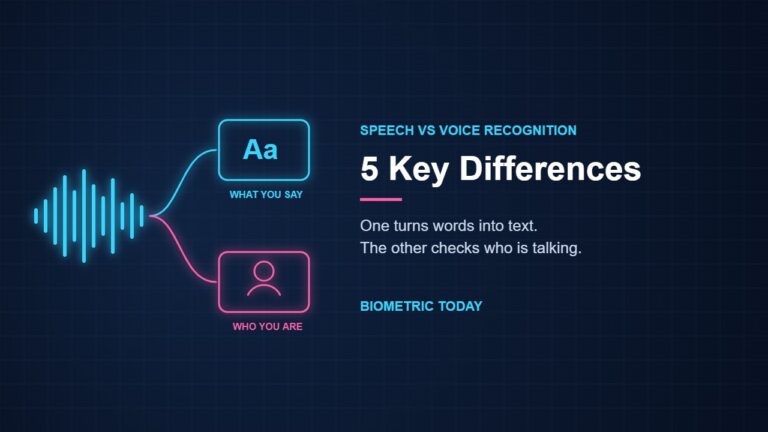
In biometrics, voice recognition technology identifies a person from the sound of their voice. It is different from speech recognition, which turns words into text. Your phone assistant does the second job; a bank’s voice check does the first.
How does voice recognition work?
The system records a few seconds of speech and measures features shaped by your throat, mouth and nasal passages. AI models turn them into a voiceprint, a set of numbers. A new call is compared with that voiceprint and scored.
Why do voice biometrics matter?
Voice is the only biometric that works over an ordinary phone line. That makes it useful for call centers and remote services. It is also the trait AI can now imitate most easily, which changes how much it can be trusted on its own.
Voice Identification vs Speech Recognition
The two terms get mixed up all the time. Speech recognition asks, “What was said?” Voice identification asks, “Who said it?”
Biometric voice recognition sits in the second group. It does not need to understand your words, and some systems work in any language. What it cares about is the physical and habitual signature in your voice: pitch, resonance, rhythm and accent.
Read the full guide
Speech Recognition vs Voice Recognition: What You Say vs Who You Are
Five differences between knowing what you say and knowing who you are.
How Does Voice Recognition Work?
Modern systems use deep neural networks trained on thousands of speakers. They map each voice to a point in a mathematical space, so voices of the same person land close together. The decision depends on how close the new sample lands to your stored voiceprint.
The “check” step has become vital. Anti-spoofing models listen for the traces left by recordings, speakers and synthetic voices, which human ears often miss.
Active vs Passive Voice Biometrics
| Area | Active (text-dependent) | Passive (text-independent) |
|---|---|---|
| What you do | Repeat a set phrase, such as “my voice is my password” | Just talk normally |
| When it runs | At the start of a call or login | In the background during the conversation |
| Speech needed | A few seconds | Longer stretches of natural speech |
| Typical use | Phone banking, helplines | Call centers, fraud screening |
Passive voice biometrics feel invisible, which is their selling point. It is also their weakness from a privacy view, because a caller may not realize a voiceprint is being made.
Voice Biometrics in Banking and Government
Voice based authentication spread fastest in phone banking, where it replaced security questions. Some tax and benefit agencies adopted it too.
Consent has been the sticking point. In 2019 the UK privacy regulator ordered the tax authority to delete about five million voiceprints collected without clear consent. The service continued only for callers who agreed.
Read the full guide
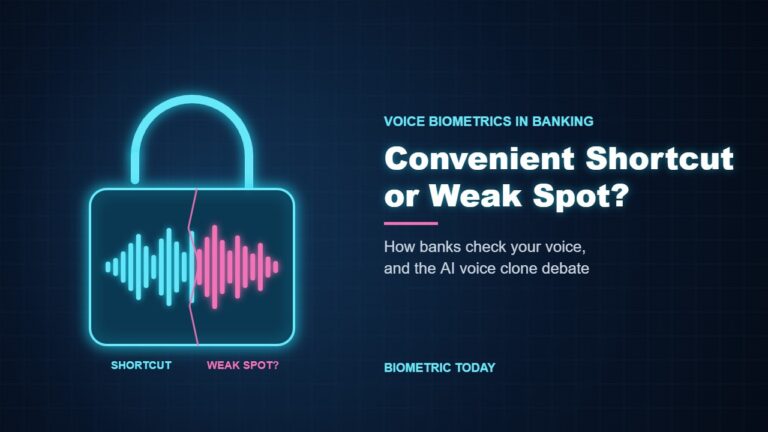
Voice Biometrics in Banking: How Comfortable Are You?
How banks use your voice, and how comfortable you should be with it.
AI Voice Recognition and the Deepfake Problem
AI cuts both ways. It made voice matching far more accurate, and it made voices far easier to fake. A short clip from social media can now be enough to clone how someone sounds.
In July 2025, OpenAI’s chief executive told a Federal Reserve conference that voiceprint checks at banks are outdated, saying “AI has fully defeated that”. Voice vendors reply that detection has improved too, and that voice is rarely used alone. Both claims shape how banks now design phone security.
The safer pattern is voice as one signal among several. A call might also check your phone number, your device and your account behavior before money moves.
Choosing a voice recognition program for a business?
Ask about deepfake and replay detection, how consent is recorded, where voiceprints are stored and what happens when the check fails. Our comparison of voice biometrics software for businesses is on the way.
Questions Still Open
Should any bank still let your voice alone move money? How should a caller be told that a voiceprint is being made? And if a voice clone fools a system, who pays for the loss, the bank or the customer?
Explore voice biometrics
FAQ
Is voice recognition the same as speech recognition?
No. Voice recognition identifies the speaker. Speech recognition transcribes the words. A voice assistant uses mostly speech recognition; a bank’s caller check uses voice recognition.
Can a voice recognition app identify anyone?
Consumer voice recognition apps mostly do speech-to-text or recognize the phone’s owner for wake words. Identifying strangers from their voice needs a stored voiceprint to compare against.
Can AI clone my voice to beat voice authentication?
It can fool some systems, especially older ones without spoof detection. That is why banks increasingly combine voice with other checks rather than relying on it alone.
Does a cold change my voiceprint?
A heavy cold or a hoarse throat can lower the match score and cause a failed check. Your underlying voiceprint does not change, so the check usually works again once you recover.
Latest voice biometrics news
New articles on this topic are on the way.
Voice biometrics guides and explainers
Related topics
References
- Computer Weekly, HMRC begins deleting unlawful voice biometric data, May 2019
- Associated Press via BNN Bloomberg, OpenAI’s Sam Altman warns of AI voice fraud crisis in banking, July 2025
