Say “Hey Google, what’s the weather?” and two quite different things can happen inside your phone. One part works out the words you said. Another part may check whether the voice belongs to you.
Those two jobs sit at the heart of speech recognition vs voice recognition. People mix them up all the time and the names don’t help.
Here’s the simplest way to remember the difference between speech and voice recognition.
Speech recognition understands what you say. Voice recognition works out who is saying it.
The first is about language. The second is about identity. That’s why voice recognition counts as a biometric and speech recognition doesn’t.
Speech recognition: turning words into text
Speech recognition (also called automatic speech recognition or ASR) listens to sound and writes down the words. It doesn’t care who you are. It only cares what you said.
How it works
A microphone records your voice as a sound wave. Software slices that wave into tiny pieces and looks for the sounds of language.
Modern systems use large neural networks trained on huge amounts of recorded speech. They predict the most likely words and sentences from those sounds.
A quick look back
The idea is older than most people think. IBM showed a machine called Shoebox in 1961. It understood the digits zero to nine and six command words such as “plus” and “minus.”
Today’s models are in another league. OpenAI’s Whisper was published in 2022 and trained on 680,000 hours of audio. On a standard test of clean read speech its best model got about 2.5% of words wrong.
Where you meet it
- Dictation on your phone or laptop
- Live captions on video calls and on TV
- Voice assistants working out your request
- Call centres that turn calls into text
- Doctors dictating patient notes
Accuracy still drops with heavy accents, background noise and people talking over each other. That’s worth knowing before you trust an automatic transcript of an important meeting.
Voice recognition: working out who is speaking
Voice recognition (experts often say speaker recognition) checks the person behind the voice. It’s a biometric because it measures something personal about you.
Your voice is shaped by your body. The size of your throat, mouth and nasal passages gives it a unique sound. How you speak adds more through your rhythm and accent.
How it works
First you enroll. You speak a few phrases and the system builds a voiceprint. That’s a set of numbers describing how you sound.
The next time you speak it builds a fresh voiceprint and compares the two. If they’re close enough you pass.
Some systems ask you to say a fixed phrase. Others listen to any natural speech, which is called text-independent recognition. The US National Institute of Standards and Technology has run speaker recognition tests since 1996 to measure how well these systems work.
Where you meet it
- Phone banking. HSBC UK said its Voice ID stopped almost £249 million of attempted fraud in one year and was used by over 2.8 million customers.
- Smart speakers. Google’s Voice Match lets the Assistant give you personal results only when it recognizes your voice.
- Call centres. Some firms check callers quietly in the background while they talk.
- Forensics. Investigators sometimes compare voices on recordings.
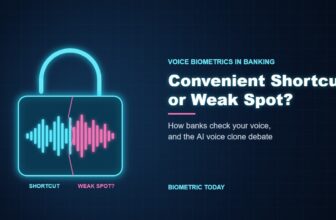
We look at the banking side in detail in our article on voice biometrics in banking.
Speech recognition vs voice recognition: 5 key differences
So what really separates the two? The difference between speech recognition and voice recognition comes down to five things.
1. They answer different questions
Speech recognition asks what was said. Voice recognition asks who said it.
2. Only one of them is a biometric
Voice recognition measures something personal about your body and habits, so your voiceprint counts as biometric data. Speech recognition only handles the words and doesn’t try to identify you.
3. One needs you to enroll first
Speech recognition works for anyone who talks. Voice recognition has to hear you first so it can build your voiceprint.
4. They keep different data about you
Speech systems keep audio and transcripts of what you said. Voice systems keep a voiceprint that is tied to your identity.
5. They fail in different ways
Speech recognition struggles with heavy accents, background noise and people talking over each other. Voice recognition struggles with colds, bad phone lines and AI voice clones.
Voice vs speech recognition at a glance
Here’s the whole speech recognition vs voice recognition comparison in one table.
| Speech recognition | Voice recognition | |
|---|---|---|
| Main question | What was said? | Who said it? |
| Output | Text or a command | A match or no match |
| Is it biometric? | No | Yes |
| Needs you to enroll? | No | Yes, to build your voiceprint |
| Works for anyone? | Yes, any speaker | Only for enrolled people |
| Common examples | Dictation, captions, voice search | Phone banking checks, Voice Match |
| Main weakness | Accents, noise and crosstalk | Colds, bad lines and voice clones |
| Data it keeps | Audio and transcripts | A voiceprint linked to your identity |
How each one is measured
The two do different jobs and are scored in different ways. Knowing the scores helps you read the claims companies make.
Speech recognition: word error rate
Speech systems are judged by their word error rate. It counts the words a system gets wrong, leaves out or adds as a share of all the words spoken.
A 5% word error rate means about one mistake in every 20 words. That sounds small until you read a transcript of a fast meeting with five people talking.
Voice recognition: two kinds of mistakes
Voice systems can fail in two directions. They can let the wrong person in, which is called a false accept. Or they can turn the right person away, which is a false reject.
The two pull against each other. Make the system stricter and it lets in fewer impostors but annoys more real customers.
A bank chooses that balance based on risk. So a claim like “99% accurate” means little unless you know which of the two mistakes it refers to.
Where the two work together
Often you get both at once, so voice vs speech isn’t an either-or. A smart speaker first checks whose voice it heard. Then it works out what that person asked for.
That’s how a family speaker can read out your calendar but not your partner’s. Voice recognition picks the person and speech recognition handles the request.
Banks do the same on the phone. As you explain why you’re calling one system transcribes your words and another quietly confirms it’s really you.
This pairing is part of a bigger move toward biometric authentication in everyday services.
Privacy, voice clones and the debate
Voice recognition ties a voice to a person, so it raises bigger privacy questions. Your voiceprint is biometric data. Illinois’ biometric privacy law even lists voiceprints by name.
Speech recognition has its own worries. Recordings and transcripts can reveal a lot about your life even if no one checks who you are.
Then there are voice clones. The US Federal Trade Commission has warned that scammers can copy a voice from a short clip posted online. They then call relatives and fake an emergency.
That raises a hard question for voice recognition. Can a machine still trust your voice when another machine can copy it?
Supporters say modern systems look for signs of a live human and pair voice checks with other signals. Critics say voice alone is no longer enough for anything important.
Which side convinces you may depend on what’s being protected. A playlist is one thing. Your savings are another.
Voice is only one of many traits machines can read. Our guide to the types of biometrics puts them side by side.
Speech recognition vs voice recognition: quick answers
Is Siri speech recognition or voice recognition?
Both. Siri uses speech recognition to understand your request. It can also learn your voice so it responds to “Hey Siri” from you more reliably.
Is voice recognition the same as voice biometrics?
Yes, in most uses. Voice biometrics is the security term for recognizing a person by their voice.
Is speech recognition a biometric?
No. It turns speech into text for anyone who talks. It doesn’t try to identify the speaker.
Voice vs speech: what’s the difference in plain English?
Your voice is the sound you make. Speech is the words you form with it. Technology follows the same split: speech recognition reads the words and voice recognition reads the voice.
Which is more accurate?
They answer different questions, so they’re measured differently. Speech recognition is judged by how many words it gets wrong. Voice recognition is judged by how often it lets the wrong person in or keeps the right person out.
Can a cold stop voice recognition from working?
Sometimes. A blocked nose or a sore throat changes how you sound. Many systems then fall back to a PIN or security questions.
Words or identity: which matters more to you?
In the end speech recognition vs voice recognition is a choice between words and identity. Speech recognition makes life easier by listening to your words. Voice recognition promises security by listening to you.
So here’s the question. Would you let your voice unlock your bank account? Or would you rather your devices only listened to what you say and never to who you are?
Sources
- IBM: Speech recognition (IBM history)
- Radford et al., OpenAI: Robust Speech Recognition via Large-Scale Weak Supervision (2022)
- NIST: Speaker Recognition
- HSBC UK: Voice ID prevents £249 million of attempted fraud (May 2021)
- Google Assistant Help: Turn on voice recognition with Voice Match
- US Federal Trade Commission: Scammers use AI to enhance their family emergency schemes (March 2023)