
What Is Biometrics? Meaning, Examples and How It Works
Biometrics is the use of your body, or the way you behave, to prove who you are. Your phone does it when it opens at a glance. A border gate does it when it checks your fingerprints against your passport.
What is biometrics?
Biometrics means recognizing people automatically from their biological and behavioral traits. Fingerprints, faces, irises and voices all count. So do quieter signals, such as the rhythm of your typing.
How does biometrics work?
A sensor captures a sample, such as a photo of your face. Software turns it into a template of numbers and compares it with one stored earlier. If the match score clears a set threshold, the system accepts you.
Why does biometrics matter?
You can forget a password, but you always carry your face. That convenience has put biometrics inside phones, passports, bank apps and national ID systems. It also raises the stakes of a leak, because you cannot reset a fingerprint.
Biometrics Meaning: More Than a Buzzword
The word joins two Greek roots: bios (life) and metron (measure). It first belonged to biologists who measured living things. Today, when people ask what biometric means, they almost always mean identity.
The international standard for the field gives the modern biometrics definition in one line: the automated recognition of individuals based on their biological and behavioral characteristics. Two words in that line matter most. “Automated” means a machine does the comparing, not a person. “Recognition” means the goal is to tell people apart.
So a doctor measuring your heart rate is not doing biometrics. A smartwatch that uses your heart rhythm to unlock a payment is.
How Do Biometrics Work? Five Steps
The first time you use a system, you enroll. The sensor captures your trait, and software keeps a compact template rather than a full picture. Most phones store that template in a locked chip and never send it anywhere.
Every later check is a comparison. No two scans are ever identical, so the system scores how similar they are. A strict threshold rejects more impostors but also turns away more real users, which is why no system is perfect.
Good systems also check that the sample comes from a live person. This step, called liveness detection, is what stops a printed photo or a silicone finger.
Read the full guide
Biometric Authentication Explained: Methods, Steps and Trade-offs
How biometric checks fit into logins, payments and multi-factor security.
Types of Biometric Technology
Biometric traits fall into two groups. Physical traits are part of your body. Behavioral traits come from how you act.
| Trait | What is measured | Where you meet it |
|---|---|---|
| Fingerprint | Ridge endings and splits on the fingertip | Phones, laptops, border control, police records |
| Face | Distances and shapes across the face | Phone unlock, airport gates, photo apps |
| Iris | Texture of the colored ring of the eye | National ID, some borders and refugee aid |
| Voice | How your vocal tract shapes sound | Bank and tax helplines |
| Palm and vein | Vein patterns under the skin | ATMs in Japan, some payment pilots |
| Behavior | Typing rhythm, swipes, walking style | Fraud checks running in bank apps |
Each trait trades accuracy against ease. An iris camera is very precise but needs you to look into it. A face camera works from a distance, which is exactly why it causes the most debate.
Researchers also study rarer traits, such as ear shape, heartbeat and even tongue prints. Few of them are used outside the lab today.
Read the full guide
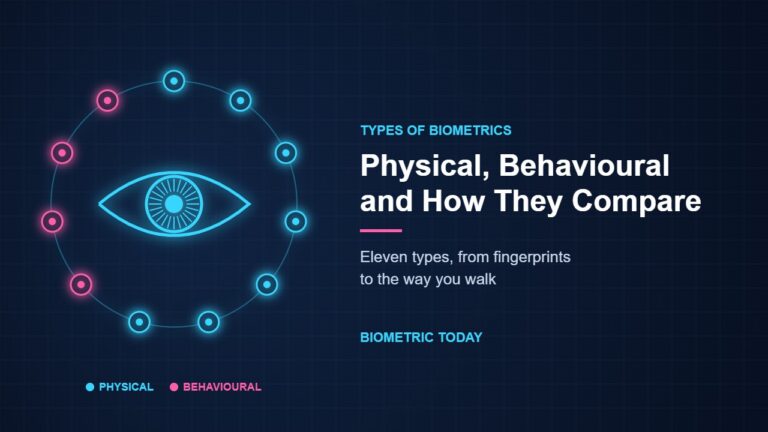
Types of Biometrics: Physical, Behavioural and How They Compare
Physical and behavioral methods side by side, with how each one compares.
Biometrics Examples You Already Use
- Your phone. Face or fingerprint unlock is the most common biometric check in the world, and it stays on the device.
- National ID. India’s Aadhaar links fingerprints, iris and face to a 12-digit number. It has issued 144.66 crore (about 1.45 billion) numbers.
- Borders. Europe’s Entry/Exit System now records a face image and fingerprints for non-EU visitors. It became fully operational on 10 April 2026.
- Payments. Since October 2025, Indian users can approve UPI payments with face or fingerprint instead of a PIN, if they opt in.
Read the full guide
Uses of Biometrics: 15 Real-World Examples, From Borders to Banks
Fifteen real projects, from borders and banks to hospitals and schools.
Verification vs Identification
Biometric systems do one of two jobs. Verification asks, “Are you who you claim to be?” It compares you against one stored template, the way your phone does.
Identification asks, “Who is this?” It searches one sample against many, sometimes millions. Police fingerprint databases and face searches do this, and it is harder to get right because every extra record is another chance for a false match.
The Trade-offs Behind the Convenience
Biometrics remove passwords from daily life, and they are hard to share or guess. That is the case for them. The case against starts with permanence: a stolen password can be changed, but a copied fingerprint template cannot.
Errors are the second concern. Even good systems wrongly reject some people, and some have worked worse for certain groups. Privacy is the third. Under Europe’s GDPR, biometric data used to identify people is a special category with extra protection, and Illinois has required written consent since its 2008 biometric privacy law.
Read the full guide
Advantages and Disadvantages of Biometrics: Safe or Scary?
The honest list of advantages and disadvantages, with real cases on both sides.
Questions Still Open
Should a company be allowed to scan your face when a card would do the same job? Who should hold the master copy of a nation’s fingerprints? And as AI gets better at faking faces and voices, which traits will stay trustworthy? Where do you draw the line?
Explore biometrics
Types of biometrics
Every major physical and behavioral method, and how they compare on accuracy and ease.
Biometric authentication
The step-by-step process behind logins, and how biometrics fit into multi-factor security.
Biometric data
What counts as biometric data, how templates are stored and what the law says.
The future of biometrics
The shifts to watch, from passkeys to deepfake defenses.
FAQ
What does biometric mean in simple words?
Biometric means measuring a part of your body, or a habit, to recognize you. A fingerprint scan on your phone is the everyday example.
What are the main types of biometrics?
There are two main groups. Physical biometrics include fingerprint, face, iris, voice, palm and vein. Behavioral biometrics include typing rhythm, touchscreen swipes and the way you walk.
What is biometric technology?
Biometric technology is the hardware and software that capture and compare these traits. It includes sensors such as cameras, fingerprint readers and microphones, plus the matching algorithms behind them.
Is biometrics safer than a password?
It is harder to guess or share, which makes it stronger for daily logins. But it cannot be changed if leaked, so the safest setups keep templates on your device and pair biometrics with something else.
Is a photo of my face biometric data?
A plain photo usually is not. It becomes biometric data when it is processed to identify you, for example by turning it into a face template.
Latest biometrics news
New articles on this topic are on the way.
Biometrics guides and explainers
-
Which Biometric Is Most Accurate? Fingerprint vs Face vs Iris vs Voice
-
Biometric Authentication Explained: Methods, Steps and Trade-offs
-
What Is Biometric Data? Examples, Templates and What the Law Counts
-
Uses of Biometrics: 15 Real-World Examples, From Borders to Banks
-
Types of Biometrics: Physical, Behavioural and How They Compare
-
Your Body Is the New Password: 8 Shifts Shaping the Future of Biometrics
-
Advantages and Disadvantages of Biometrics: Safe or Scary?
Related topics
References
- ISO/IEC, ISO/IEC 2382-37:2022 Vocabulary, Part 37: Biometrics, 2022
- UIDAI, Aadhaar enrolment dashboard, 2026
- European Commission, The new Entry/Exit System went live on 12 October, October 2025
- The Week, UPI biometric payments and Aadhaar face authentication, October 2025
- EUR-Lex, General Data Protection Regulation (EU) 2016/679
- Illinois General Assembly, Biometric Information Privacy Act (740 ILCS 14)
