
Retina Scan: How Retinal Recognition Works and Why It Is Rare
A retina scan identifies you from the blood vessels at the back of your eye. It was one of the first biometrics ever built into a machine, and it is still among the most precise. It is also one of the rarest, for reasons that have little to do with accuracy.
What is a retina scan?
A retina scan maps the network of blood vessels on the retina, the light-sensitive layer lining the back of the eye. That branching pattern is distinctive enough to tell people apart, including identical twins.
How does a retina scan work?
You look into an eyepiece and focus on a small light. A low-energy infrared beam sweeps across the retina, and blood vessels absorb more of it than the tissue around them. The reflection pattern is turned into a template and compared.
Why are retina scans rare?
The scan needs your eye a few centimeters from the lens and your full cooperation. Iris and face cameras work from farther away and cost less. So retina scan biometrics stayed in a few high-security niches.
A Short History of Retina Scan Biometrics
The idea came from two New York doctors, Carleton Simon and Isidore Goldstein. In 1935 they noticed that the pattern of retinal blood vessels differed from person to person and proposed it for identification.
It took four decades to build a machine. EyeDentify, founded in the 1970s, sold the first commercial retinal scanner in the early 1980s. Government agencies and secure facilities adopted it, and films made it the classic spy-movie door lock.
The technology never went mainstream. Researchers who reviewed the field noted that the last scanner from that pioneer company was the ICAM 2001, and that no fully automatic retina scanner had yet reached the market.
How a Retina Scan Works, Step by Step
Because the retina sits inside the eye, it is very hard to photograph without the person’s help. That makes spoofing difficult. It also means the scan feels intrusive to many users, who must hold still with an eye pressed close to a device.
Retina Scan vs Retinal Imaging: Not the Same Thing
Many people searching for a retina scan actually mean an eye test. Retinal imaging is a medical photo of the back of the eye. Opticians and eye doctors use it to look for disease, and digital retinal imaging is now a routine part of many eye exams.
A retinal screening is a specific health check of this kind. People with diabetes, for example, are offered regular diabetic eye screening to catch damage to the retina early.
| Area | Biometric retina scan | Medical retinal imaging |
|---|---|---|
| Purpose | Prove who you are | Check the health of your eye |
| Who runs it | Security systems | Opticians and eye doctors |
| What is kept | A vessel-pattern template | Detailed photos for your medical record |
| What changes the result | Little, unless eye disease alters the vessels | Disease is exactly what it looks for |
The overlap matters for privacy. A retinal image can reveal signs of conditions such as diabetes or high blood pressure. That is one more reason biometric systems store only a template, not the full picture.
Retina Scan vs Iris Scan
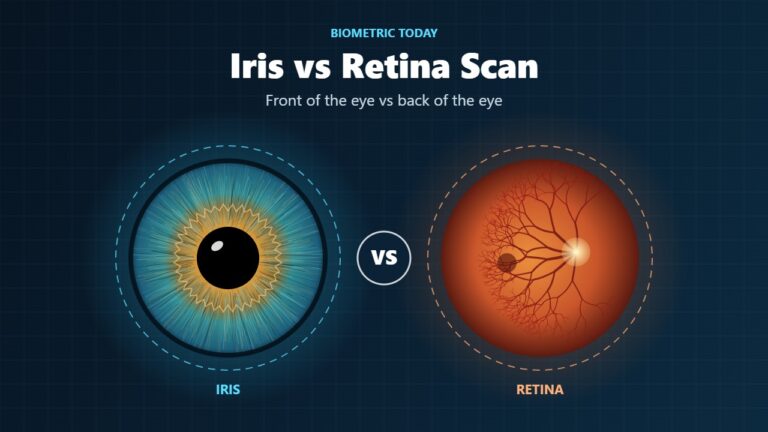
Both look at the eye, so they are often confused. An iris scan photographs the colored ring at the front, from up to about a meter away. A retina scan looks through the pupil to the back of the eye, from a few centimeters.
Iris recognition won the market because it is faster, friendlier and nearly as accurate. Today, when a border gate or ID program scans your eye, it is almost always reading your iris.
Read the full guide
Iris vs Retina Scan: What’s the Difference?
The full comparison of iris and retina scans, and why one won.
Questions Still Open
Could phone cameras one day read your retina, and should they? Since a retinal image can hint at your health, who should be allowed to see it? And is extra precision worth a scan that most people find uncomfortable?
Explore retina scans
FAQ
Is a retina scan safe?
A biometric retina scan uses a low-energy infrared beam for a few seconds. It is designed to stay within eye-safety limits and does not use a cutting laser.
Can a retina scan detect disease?
A biometric scanner is not built to diagnose anything and keeps only a template. Medical retinal imaging, done by eye doctors, is what checks for disease.
Can glasses or contact lenses affect a retina scan?
Glasses usually need to come off so the eye can sit close to the lens. Contact lenses generally do not block the scan.
Is retina scanning used at airports?
Very rarely. Airport and border systems use face and iris recognition, which work faster and from a distance.
Latest retina scan news
New articles on this topic are on the way.
Retina scan guides and explainers
Related topics
References
- Springer (Drahansky et al.), Retina Recognition, 2019
- Brno University of Technology, Retinal Vascular Characteristics
- NHS, Diabetic eye screening
