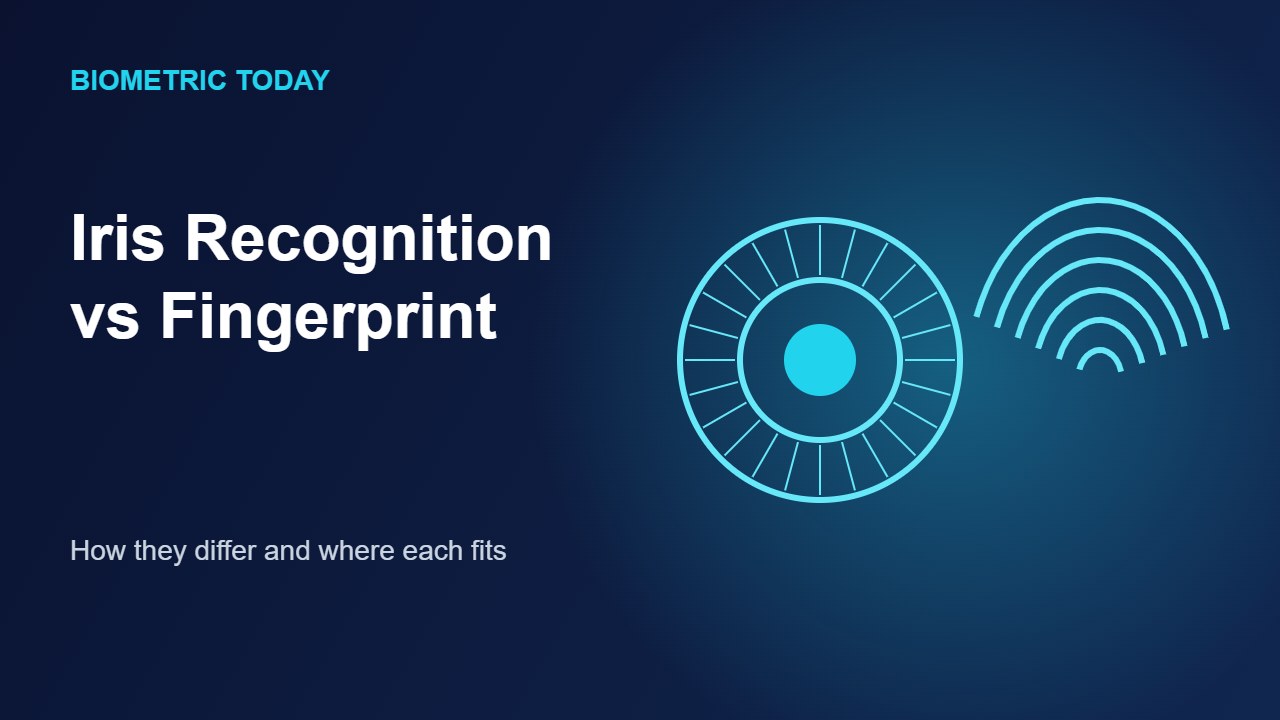
Iris recognition vs fingerprint sounds like a simple contest. It is not. Both turn a body trait into a mathematical template and compare it with a stored one, but they capture different things in different ways.
A fingerprint is the pattern of ridges on your fingertip. An iris is the colored ring of tissue around your pupil, read with near-infrared light. This guide puts them side by side so you can see where each one tends to fit.
You will also see why the published accuracy numbers for the two cannot be lined up in one column. That matters whenever someone tells you one is simply better.
How iris recognition and fingerprint recognition work
Fingerprint: ridges, minutiae and touch
A fingerprint sensor reads the ridges and valleys on your skin. Software then picks out landmarks called minutiae, such as ridge endings and splits, and stores their positions as a template. Our guide to fingerprint patterns like loops, whorls and arches covers the pattern types in more detail.
Optical, capacitive and ultrasonic sensors all do this job in different ways. What they share is contact: your finger has to touch or sit very close to the glass.
Iris: texture, near-infrared light and distance
An iris scanner takes a close picture of your eye under near-infrared light. The software finds the iris, removes the parts hidden by eyelids and lashes, and turns the fine texture into a compact code. The full story is in our complete guide to iris recognition.
Nothing touches the device. Depending on the camera, the eye can be a few inches away or a bit farther. Reflections, heavy eyelids and some eyewear can still block part of the image.
Iris scan vs fingerprint at a glance
Here is a quick comparison of the two methods. The details depend on the device and the setting, so treat the rows as general patterns.
| Area | Fingerprint | Iris |
|---|---|---|
| What is read | Ridge pattern on the fingertip | Texture of the iris ring in the eye |
| Contact needed | Yes, a touch or press | No, a camera reads the eye |
| Light used | Visible light, electrical or ultrasound, by sensor type | Near-infrared illumination |
| Typical places | Phones, laptops, door locks, police records | Border programs, national ID, high-security doors |
| What can get in the way | Dry, worn or wet skin, cuts, dirt | Eyelids, lashes, reflections, some eyewear |
| Change over time | Skin can wear with age or heavy manual work | Texture is stable for years, per NIST research |
| Everyday exposure | Prints are left on touched surfaces | The eye is seen in photos and cameras, but the fine texture needs a close infrared image |
Iris recognition vs fingerprint accuracy: what NIST measures
Accuracy is where most comparisons go wrong. The two methods are tested in different programs, on different data, with different metrics. A figure for one cannot simply be set next to a figure for the other.
For iris, NIST runs the NIST IREX 10 identification track. It scores algorithms by their miss rate (FNIR) at a false positive rate (FPIR) of 0.01. The two-eye test enrolls 500,000 people, and the single-eye test enrolls one million irides from those same 500,000 people. That is a search across a large gallery, not a one-to-one unlock.
For fingerprints, NIST runs the Proprietary Fingerprint Template evaluations. In the NIST PFT III report for one tested algorithm, results are false non-match rates (FNMR) at fixed false match rates (FMR) from pairwise comparisons. At an FMR of 0.0001, the ten-finger FNMR on the Arizona DPS data was 0.004, or about 0.4 percent. Single fingers ranged from 0.31 percent for the thumbs to 0.62 percent for the left little finger.
So which is more accurate? The honest answer is that it depends on the algorithm, the capture quality and the question being asked. Our wider look at how accurate biometrics are explains the metrics behind these numbers.
Fingerprint vs iris scanner in daily use
Phones, laptops and door locks
Fingerprint sensors are small, cheap and quick, which is why they sit in so many phones, laptops and smart locks. You touch, it matches against one stored template, and you are in. That one-to-one check is the easiest job for any biometric.
Borders, national ID and large databases
Iris systems show up where a program needs to search many people without contact. India’s Aadhaar program, for example, collects both iris and fingerprints. The NIST iris test above is built around that kind of large search.
Wear, age and stability
Fingerprints can fade for people who work with their hands or have very dry skin. Iris texture looks steadier. In its NIST IREX VI study, NIST found no evidence of a widespread aging effect on iris recognition, and an earlier rise in rejections was traced to changes in pupil dilation.
That does not make iris trouble-free. Capture quality, lighting and user behavior still decide how often a scan works on the first try.
Security and privacy: spoofing, consent and data
Both methods can face presentation attacks, where someone shows a fake trait to the sensor. Good systems add liveness checks, and results vary a lot by product. Our guide to biometric authentication covers how those checks fit into a login flow.
Privacy concerns differ in shape. Fingerprints are left on glasses and door handles. An iris needs a close infrared image, but a camera at a gate can capture it without much effort from you, so consent and notice matter. For both, the template is personal data. See what counts as biometric data and what rules may apply.
Iris vs fingerprint scorecard by situation
There is no single winner here. This table shows which points tend to help each method in common situations.
| Situation | Points that help fingerprint | Points that help iris |
|---|---|---|
| Touch-free use | Needs contact | No contact needed |
| Device cost and availability | Widely built into phones and laptops | Less common in consumer devices |
| Large-gallery search | Proven in police and ID systems | Tested at 500,000-person scale by NIST |
| Manual workers and dry skin | Wear can cause misreads | Skin condition does not matter |
| Bright light and eyewear | Not affected | Reflections and eyewear can interfere |
| Consent and awareness | You choose to touch the sensor | Capture can feel less obvious to the person |
FAQ
Is iris recognition more accurate than fingerprint recognition?
NIST measures them with different tests, data and metrics, so there is no fair head-to-head number. Both can perform very well when the capture is good. The right pick depends on the setting.
Which is harder to fake?
Neither is immune. Fake fingers and printed eye images have both been studied as attacks. The strength of the defense depends on the liveness detection in the product, not only on the trait.
Can a system use both together?
Yes. Programs such as Aadhaar collect both, and combining them is called multimodal biometrics. A second trait can help when one is hard to capture.
Questions to think about
Would you rather touch a sensor or look into a camera at a gate? How much does it matter to you whether capture is obvious? And if a system could use both, who should decide when each one is asked for?
Sources
- NIST: IREX 10 Identification Track
- NIST: Proprietary Fingerprint Template Evaluation III, ROC report
- NIST: Study advances use of iris images as a long-term form of identification