
Iris Recognition: How an Iris Scan Works and Where It Is Used
An iris scan reads the colored ring of your eye and turns its texture into a code. Iris recognition is one of the most accurate biometrics ever deployed. It checks identities for more than a billion people in India and guards borders, refugee camps and high-security doors.
What is iris recognition?
Iris recognition identifies a person from the patterns in the iris, the colored muscle around the pupil. Those patterns of crypts, furrows and rings form before birth and differ even between your left and right eye.
How does an iris scan work?
A camera photographs the eye under near-infrared light, which shows detail even in dark brown eyes. Software finds the iris, unwraps it into a flat strip and encodes its texture as a binary code. Two codes are then compared bit by bit.
What is iris recognition used for?
It is used where mistakes are costly: national ID, border control, aid distribution and secure buildings. Its high accuracy makes it a strong choice for searching very large databases, where a less precise method would throw up false matches.
What Is the Iris, and Why Is It So Distinctive?
The iris is the thin, circular muscle that gives your eye its color and controls how much light reaches the pupil. Seen up close, it is full of detail: ridges, pits, freckles and radial lines.
That detail is mostly random. It forms in the womb and is not decided by genes alone, so identical twins have different irises. It is also protected behind the clear cornea, which keeps it stable for decades.
How an Iris Recognition System Works
Most iris systems still use ideas published by Cambridge scientist John Daugman, whose method was patented in 1994. His algorithm encodes each iris as 2,048 phase bits, plus a mask that marks areas hidden by eyelids or lashes.
Comparing two codes is fast, because the computer only counts how many bits differ. That speed lets an iris identification system check one person against millions of records in seconds.
How Accurate Is an Iris Scan?
Iris recognition earned its reputation in testing. In Daugman’s analysis of 9.1 million comparisons between different eyes, the codes never came close enough to be confused. Large national programs have since used it to find people who try to enroll twice.
It is not flawless in practice. Poor focus, heavy eyelids, some contact lenses and certain eye conditions can cause a scan to fail. Cataract surgery can also change how an iris looks to the camera, so some systems ask people to enroll again.
Read the full guide
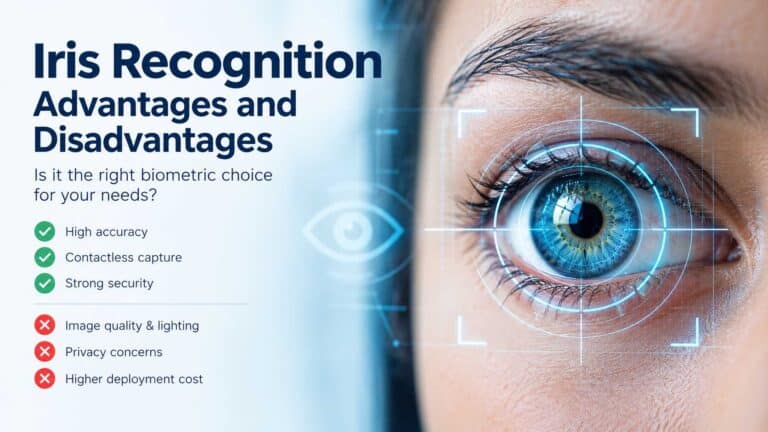
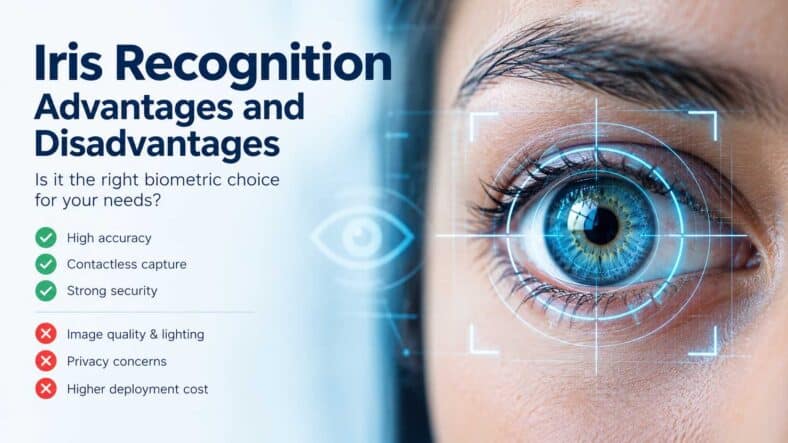
Iris Recognition Advantages and Disadvantages in 2026
The full list of strengths and weaknesses, from accuracy to privacy.
Iris Scan vs Retina Scan vs Face
| Area | Iris scan | Retina scan | Face recognition |
|---|---|---|---|
| What it reads | Texture of the colored ring | Blood vessels at the back of the eye | Shape of the whole face |
| Distance | 10 cm to about 1 m | A few centimeters, eye at a lens | Up to many meters |
| Accuracy for large searches | Very high | Very high | High, more affected by pose and lighting |
| Can it work without your knowledge? | Rarely | No | Yes |
| Everyday use | National ID, borders, aid | Rare, high-security sites | Phones, airports, CCTV |
That last row explains much of the debate. Iris and retina scans need your cooperation, while face recognition can work from a distance.
Read the full guide
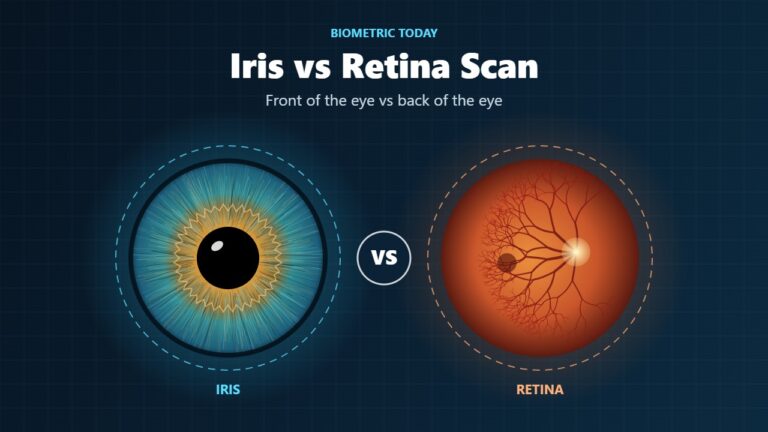
Iris vs Retina Scan: What’s the Difference?
How iris and retina scans differ, and why the iris won out.
Where Eye Recognition Technology Is Used
- National ID. India’s Aadhaar captures both irises of every adult, alongside fingerprints and a photo.
- Aid and refugees. Humanitarian agencies use iris scans to deliver cash and food to the right person without cards.
- Borders and airports. Some countries use iris gates for frequent travelers, though many have since moved to face.
- Devices. Apple’s Vision Pro headset unlocks with Optic ID, an iris check. Some older Samsung phones had iris scanners too.
- Digital identity. World (formerly Worldcoin) scans irises with its Orb to prove a person is human, a project that has drawn privacy regulators’ attention in several countries.
Choosing an iris scanner?
Look for near-infrared capture, certified accuracy, liveness detection and, for India, an approved registered device for Aadhaar. Our buyer’s guides and hands-on reviews of iris scanners are on the way.
Questions Still Open
Should a private company be allowed to build a global database of irises, even with consent? If an iris code leaks, can anything be done to replace it? And as cameras improve, how long before an iris can be read from a distance without you knowing?
Explore iris recognition
FAQ
What is an iris scan?
An iris scan is a near-infrared photo of the colored part of your eye, taken to identify you. The scanner does not look inside the eye and does not check your health.
Is an iris scan safe for your eyes?
Iris cameras use low-power near-infrared light, similar to many TV remote controls, within eye-safety limits. It is a photograph, not a laser.
Do identical twins have the same iris?
No. Twins’ irises are as different as those of strangers, because the fine texture forms randomly in the womb.
Can glasses or contact lenses block an iris scan?
Clear glasses and lenses usually work. Tinted, patterned or cosmetic lenses can block the texture and cause a failed scan.
Latest iris recognition news
New articles on this topic are on the way.
Iris recognition guides and explainers
Related topics
References
- John Daugman, IEEE, How Iris Recognition Works, January 2004
- USPTO, US Patent 5,291,560: Biometric personal identification system based on iris analysis, March 1994
- UIDAI, Aadhaar enrolment dashboard, 2026
