
Fingerprint Recognition: How It Works, Where It’s Used and How Accurate It Is
Fingerprint recognition is the oldest biometric still in daily use. Police have relied on it for more than a century, and it now sits under the power button of millions of phones. The ridges on your fingertips form early in the womb and keep their pattern for life.
What is fingerprint recognition?
Fingerprint recognition identifies a person by the ridge patterns on their fingertips. A biometric fingerprint is not stored as a picture in most systems. It is stored as a map of the tiny points where ridges end or split.
How does fingerprint recognition work?
A sensor captures the ridges and valleys of your finger. Software finds the key points, called minutiae, and records their position and direction. It then compares that map with a stored one and scores how many points line up.
Why does fingerprint recognition matter?
Fingerprints are cheap to capture, quick to check and very hard to share by accident. That is why they protect phones, national IDs and border crossings. They are also the core of criminal records, which makes accuracy a question of justice, not just convenience.
Fingerprint Characteristics: What Makes Each Print Unique
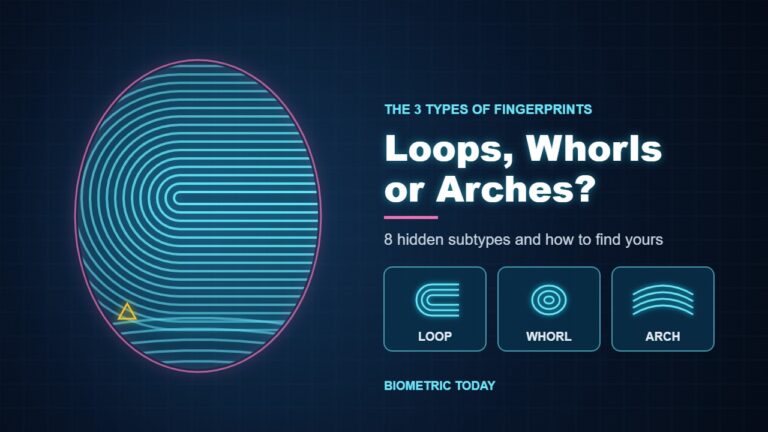
Every print has a general pattern: a loop, a whorl or an arch. That pattern helps sort prints, but it is shared by millions of people. What makes a print unique is the fine detail inside it.
Experts call these details minutiae. The two most common are ridge endings, where a ridge stops, and bifurcations, where one ridge splits into two. A full fingerprint holds dozens of them, and their layout is what fingerprint identification really compares.
Even identical twins, who share their DNA, have different fingerprints. The ridges are shaped by pressure and position in the womb, not by genes alone.
Read the full guide
The 3 Types of Fingerprints, 8 Hidden Subtypes and How to Find Yours
Loops, whorls and arches, the hidden subtypes and how to find yours.
How Does Fingerprint Recognition Work?
The capture step depends on the sensor. Optical sensors take a lit photo of your finger. Capacitive sensors, common in phones, measure tiny electrical differences between ridges and valleys. Ultrasonic sensors bounce sound off the skin and can read through glass.
After capture, software sharpens the image and pulls out the minutiae. The result is a template, a short list of points and angles. Your phone compares a fresh template with the one saved at enrollment, and it never needs the photo again.
Fingerprint Authentication vs Fingerprint Identification
Fingerprint authentication answers a simple question: is this the owner? Your phone, laptop or office door compares your finger with one stored template. This one-to-one check is fast and private when the template never leaves the device.
Fingerprint identification is a search. One print is compared with a whole database to find who it belongs to. Police use it for prints found at crime scenes, and border agencies use it to catch people traveling under false names.
The scale can be huge. The FBI’s identification system held more than 87 million criminal and nearly 81 million civil fingerprint records in its April 2025 fact sheet.
Fingerprint Analysis: How Accurate Is It?
In crime labs, fingerprint analysis is done by trained examiners, often after a computer suggests candidates. For decades their accuracy was simply assumed. A large FBI-backed study in 2011 finally measured it.
In that study, 169 examiners made false matches in about 0.1% of comparisons. They missed true matches far more often, at 7.5%. A second examiner checking the work caught every false match in the test.
Real cases show why that check matters. In 2004 the FBI wrongly linked an Oregon lawyer, Brandon Mayfield, to a fingerprint from the Madrid train bombings. A Justice Department review found the error came from an unusually similar print and from examiners who did not question their first conclusion.
Where You Meet Fingerprint Technology
- Phones and laptops. Unlocking, app locks and payment approval, with the template kept in a secure chip.
- National ID. Aadhaar in India and ID cards across the EU store fingerprints for identity checks.
- Borders. Europe’s Entry/Exit System takes fingerprints from non-EU visitors on their first crossing.
- Workplaces. Door readers and attendance terminals, which face strict privacy rules in Europe.
- Policing. Booking records, background checks and crime scene searches.
Read the full guide
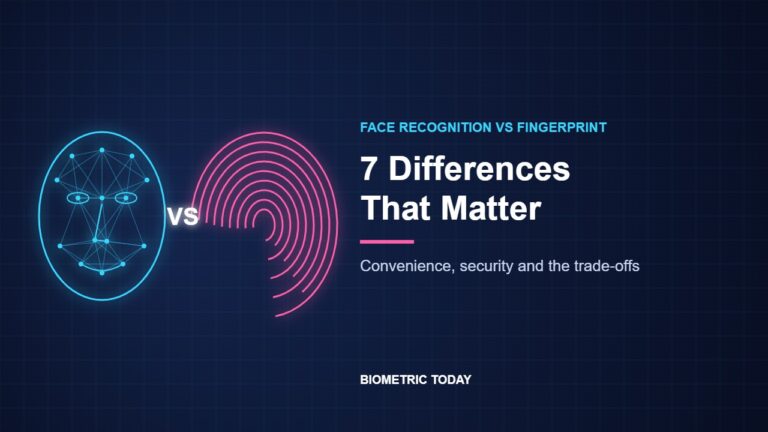
Facial Recognition vs Fingerprint: Convenience, Security and the Trade-offs
How fingerprints compare with face recognition on convenience, security and failure points.
Choosing a fingerprint scanner?
For a phone, the built-in sensor is enough for most people. For a PC, a door or an office, look at the sensor type, its certified accuracy and where templates are stored. Our buyer’s guides and hands-on reviews of fingerprint scanners are on the way.
Questions Still Open
Should police keep the fingerprints of people who were never charged? How much should a jury trust a match that rests on one examiner’s judgment? And if a fingerprint template leaks, what should the person whose finger it is be able to do about it?
Explore fingerprint recognition
FAQ
How does fingerprint recognition work on a phone?
The sensor reads your ridges, and the phone turns them into a template of key points. It compares that with the template saved when you set up the phone. The check happens inside a secure chip, and the fingerprint is not sent to the phone maker.
Can two people have the same fingerprint?
No two people have ever been shown to share a full fingerprint, including identical twins. Partial prints from crime scenes are another matter, because a small fragment can look similar to someone else’s print.
Can a fingerprint scanner be fooled?
Basic sensors have been fooled with molds made from latex, glue or 3D prints. Modern phone sensors add liveness checks that look for real skin, which makes this much harder.
Do fingerprints change with age?
The pattern stays the same for life. Skin does get drier and thinner with age, and some manual work wears the ridges down, which can make prints harder to read.
Latest fingerprint recognition news
Fingerprint recognition guides and explainers
-
Fingerprint Lock Screen: 7 Things to Know About Real vs Prank Apps
-
Iris Recognition vs Fingerprint: How They Differ and Where Each Fits
-
Facial Recognition vs Fingerprint: Convenience, Security and the Trade-offs
-
Fingerprint App Lock: Built-in Tools vs the Best App Lockers
-
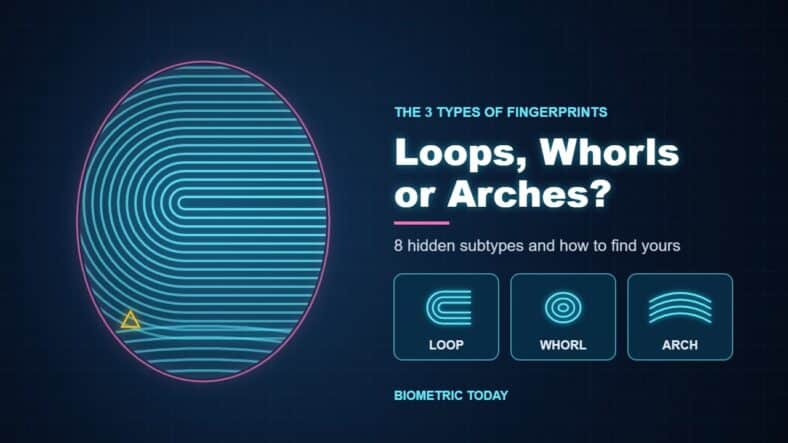
The 3 Types of Fingerprints, 8 Hidden Subtypes and How to Find Yours
Related topics
References
- FBI, Next Generation Identification (NGI) System Fact Sheet, April 2025
- PNAS (Ulery et al.), Accuracy and reliability of forensic latent fingerprint decisions, 2011
- US Department of Justice, Office of the Inspector General, A Review of the FBI’s Handling of the Brandon Mayfield Case, March 2006
- European Commission, The new Entry/Exit System went live on 12 October, October 2025
