
Biometrics at Airports: Face Boarding, Border Checks and Your Choices
Biometrics at airports have gone from pilot projects to daily routine. A camera at the gate can now replace your boarding pass, and a border kiosk can read your fingerprints in seconds. Most travelers have already met the technology, often without thinking about it.
What is biometric screening at airports?
Biometric screening at airports means checking your identity with your face, fingerprints or iris instead of, or as well as, your documents. It happens at security, at the border and increasingly at bag drop and boarding.
What is biometric boarding?
Biometric boarding lets you board a plane by looking into a camera. The system matches your face to the photo the airline or government already holds, such as your passport photo, and the gate opens if they match.
Why does it matter?
It speeds up crowded checkpoints and makes stolen boarding passes useless. It also means governments and airlines handle face data for millions of travelers, which is why opt-out rights and data deletion rules matter.
How Fast Biometrics at Airports Are Spreading
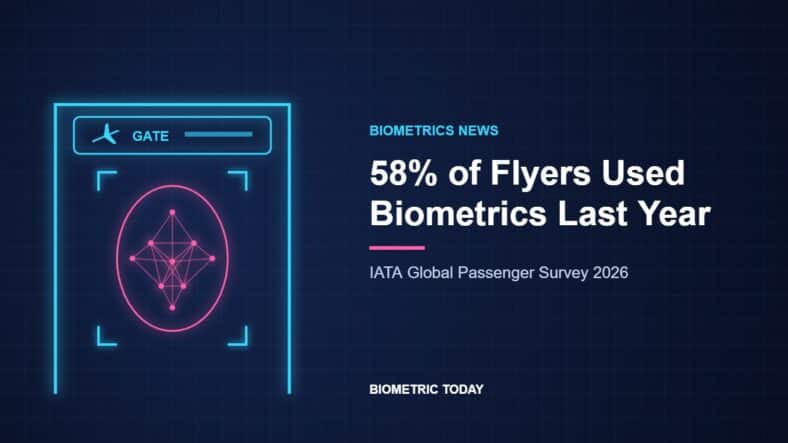
Use has climbed quickly. In the International Air Transport Association’s 2026 passenger survey of more than 10,000 travelers, 58% said they had used biometrics somewhere in the airport in the past year.
Satisfaction is high among those who tried it, at 87% in the same survey. Most respondents also said they would share biometric data to skip repeated passport and boarding pass checks.
Where Your Face and Fingerprints Are Checked
Most airport biometric screening relies on airport facial recognition, because cameras work from a distance and fit into existing lanes. Fingerprints still dominate at borders, where governments compare travelers against watch lists and visa records.
Read the full guide
Airport Face Recognition: How It Works, Where It’s Used and Your Options
How airport face recognition works, the main systems and your options.
Borders: The Biggest Change in Years
Europe made the largest single move. Its Entry/Exit System replaces passport stamps for non-EU visitors with a digital record of their face and fingerprints. It started on 12 October 2025 and became fully operational on 10 April 2026.
Other systems work the other way round, enrolling travelers who choose to join. India’s Digi Yatra lets domestic flyers pass airport gates with their face, and it has begun trials for international flights. Trusted traveler programs in many countries also rely on biometrics.
| Program | Where | Biometrics used | Who it covers |
|---|---|---|---|
| Entry/Exit System (EES) | 29 European countries | Face and fingerprints | Non-EU short-stay visitors |
| Digi Yatra | Indian airports | Face | Travelers who opt in |
| TSA PreCheck Touchless ID | US airports | Face | PreCheck members who opt in |
| e-Gates | Many countries | Face matched to e-passport chip | Eligible passport holders |
Your Choices at the Checkpoint
Rules differ by country, and so do your rights. In the US, the security agency says its face checks are voluntary. Travelers can ask for a manual ID check instead, and TSA’s Touchless ID program was set to reach 65 airports by spring 2026.
Border checks are a different matter. Where the law requires biometrics, such as Europe’s EES for non-EU visitors, refusing means you cannot cross. Before you travel, it is worth checking which steps are optional where you are going.
The Case For and Against
Supporters point to shorter queues, fewer fake documents and staff freed to focus on real risks. Airlines like that boarding a large plane can take minutes less.
Critics worry about consent and creep. Many travelers do not realize they can opt out, and a system built for boarding could later be used for something else. Error rates also matter, since a mismatch at a border can mean delay or questioning. Where should the line sit between convenience and surveillance?
Read the full guide
How Has Biometrics Improved National Security?
How border biometrics fit into wider national security systems.
Explore airports and borders
FAQ
Can I opt out of facial recognition at the airport?
Often yes for airline boarding and US security checks, where you can ask for a manual ID check. Border checks required by law, such as Europe’s Entry/Exit System for non-EU visitors, cannot be refused if you want to enter.
Is biometric boarding mandatory?
Airlines that offer face boarding still accept a normal boarding pass and passport.
What happens to my photo after biometric boarding?
It depends on the program. Many airline and US security systems say they delete the live photo soon after the match. Border systems such as the EES keep records for a set number of years.
Do children have to give fingerprints at the EU border?
Under the Entry/Exit System, children under 12 are exempt from fingerprinting, though a face image is taken.
Latest airports and borders news

Airports and borders guides and explainers

Related topics
References
- IATA, 2026 Global Passenger Survey: travelers, biometrics, AI and entry requirements, October 2026
- European Commission, The new Entry/Exit System went live on 12 October, October 2025
- The Spokesman-Review, TSA’s faster PreCheck lane is expanding to more airports, January 2026
