

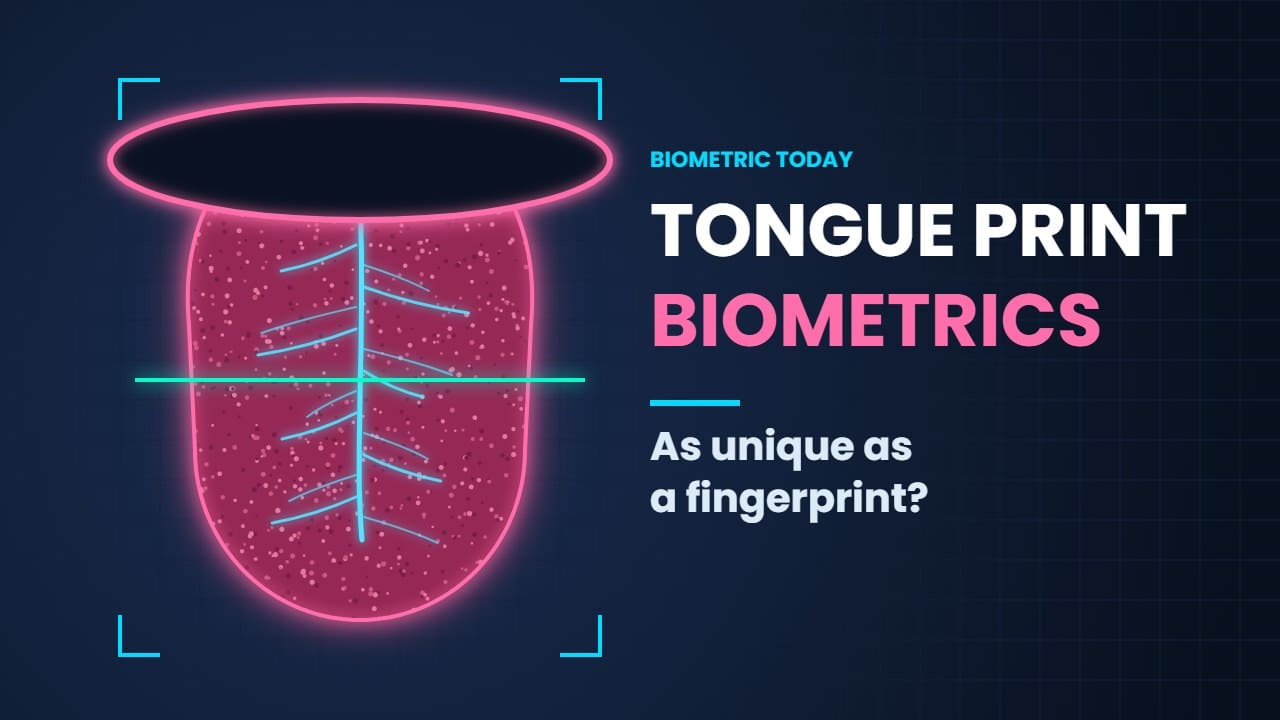
Stick out your tongue and look in a mirror. You’ll see tiny bumps, soft grooves and maybe a line running down the middle. Some scientists think that pattern could identify you just as a fingerprint does.
That idea is called tongue print biometrics. It sounds odd at first. But the tongue has a few traits that make researchers curious and a few that make them cautious.
Here’s what a tongue print is, what the studies really show and where the idea still falls short.
What Is a Tongue Print?
A tongue print is the set of visible features on the top of your tongue. It covers the overall shape, the surface texture and the fissures that run across it.
Shape is usually sorted into simple groups such as U shaped and V shaped. Fissures are the grooves. Some people have one deep line down the center while others have a web of small cracks.
The word “print” is used loosely here. Nobody presses a tongue onto ink. A camera takes a photo or a 3D scan and software reads the features from the image.
How Tongue Print Biometrics Works
A tongue print system follows the same basic path as any other biometric system.
- Capture: You stick out your tongue in front of a camera. In lab tests this often happens inside a box with fixed lighting.
- Crop: Software finds the tongue and cuts away the lips and teeth.
- Measure: It reads the shape and texture. Some systems also track how the tongue moves.
- Match: The result is compared with a stored template to say yes or no.
If that sounds familiar it’s because fingerprint and face systems work the same way. Our guide to biometric authentication walks through each step in more detail.
Why Researchers Find the Tongue Interesting
The first serious work came from the Hong Kong Polytechnic University. In 2007 a team led by Dapeng Zhang introduced the tongue print as a new biometric pattern and built a database of 3D tongue images from 134 people.
Their case rested on three simple points.
- It stays hidden. Your tongue sits inside your mouth and leaves no prints on glasses or door handles.
- It’s hard to copy. The team argued that a tongue’s mix of shape and texture is difficult to forge.
- It proves you’re alive. A real tongue twitches and squirms on its own. A 2010 follow-up in the journal Pattern Recognition used that involuntary movement as a liveness check.
That last point matters more than it seems. Fake fingers and printed face photos are a constant headache for other systems.
Are Tongue Prints as Unique as Fingerprints?
You’ll often read that tongue prints are as unique as fingerprints. The honest answer is that nobody knows yet.
Fingerprint matching has been tested on huge scales. NIST runs its fingerprint tests with enrollment sets in the millions. Tongue print studies are tiny by comparison.
A 2023 study from Mustansiriyah University in Baghdad is a good example. Researchers photographed the tongues of 138 students and trained a deep learning model to tell them apart. It picked the right person about 92% of the time.
That’s a promising lab result. But 8 misses out of 100 would be far too many for a phone or a bank. And every person in the study was a student aged 19 to 23.
Dental researchers have looked at tongue prints too. A pilot study in Chennai examined 20 patients and a study in Malaysia examined 250 people. Both describe the same patterns of shape and fissures and both call for larger studies.
So is every tongue print unique? It may well be. The large studies needed to prove it just haven’t been done.
Tongue Print vs Fingerprint at a Glance
Biometric experts judge any trait against a short checklist. It asks whether the trait is distinctive, stable, easy to capture and hard to fake. Here’s how the two compare.
| Area | Tongue print | Fingerprint |
|---|---|---|
| Proof it’s unique | Small studies only | Tested on millions of records |
| Stays the same | Can change with some health conditions | Stable for most adults |
| Easy to capture | You must stick out your tongue in good light | A quick touch on a sensor |
| Hard to fake | Hard to copy and movement helps prove it’s live | Fake fingers are a known risk |
| Leaves traces | No | Yes, on almost everything you touch |
| In real use | Research labs only | Phones, borders, banks and police |
Fingerprints also fall into neat families of loops, whorls and arches. Our guide to the types of fingerprints shows how experts sort them.
What Still Holds Tongue Prints Back
Your tongue changes. Practitioners of Traditional Chinese Medicine read the color and coating of the tongue to judge health. Researchers now train AI to spot those changes from photos.
That’s handy for medicine. For a biometric it’s a warning sign, since a trait that shifts with your health is harder to match. Some conditions change the surface directly. With geographic tongue the red patches and lines move to new spots after a few weeks or months.
It’s awkward. Few people would enjoy sticking out their tongue at a bank counter or an airport gate. A trait can be clever and still fail because people don’t want to use it.
There’s no real product yet. International data standards exist for fingerprints, faces and irises. Tongue prints have no such standard and no scanner you can buy for a phone or a border.
Every biometric trait comes with trade-offs like these. Our look at the pros and cons of biometrics covers the bigger picture.
Where Tongue Prints Could Still Fit
Tongue prints are unlikely to replace fingerprints or faces. A more realistic role is as an extra check in a multimodal system that looks at two traits together. You can see how other traits are combined in our guide to the types of biometrics.
Health care is another possible home. Clinics that already photograph tongues for diagnosis could confirm who the patient is in the same step. A 2018 paper in IEEE Access explored tongue verification for connected medical devices with exactly this idea in mind.
Forensic dentists are curious too. They see tongue features as one more clue that could help identify a person when other evidence is thin.
Quick Answers About Tongue Prints
Can a tongue print unlock your phone?
Not today. No phone uses tongue prints and the technology hasn’t left research labs.
Do identical twins have the same tongue print?
Some papers say twins’ tongues look different. None of the studies covered here tested twins directly, so it’s still an open question.
Can someone fake a tongue print?
Researchers believe it would be hard because a fake tongue wouldn’t move like a real one. Proper spoofing tests on tongue systems haven’t been published at any scale yet.
Would You Stick Out Your Tongue to Log In?
Tongue print biometrics has real strengths. It’s hidden from view, hard to copy and comes with a built-in proof of life. It also has real gaps in proof, comfort and stability.
Would you trust a tongue scan more than a fingerprint? Would you feel comfortable doing it in public? And should researchers keep chasing new traits or focus on making the old ones safer?
Sources
- Zhang D, Liu Z, Yan J, Shi P. Tongue-Print: A Novel Biometrics Pattern. ICB 2007.
- Liu Z, Yan J, Zhang D, Tang Q. A tongue-print image database for recognition. ICMLC 2007.
- Zhang D, Liu Z, Yan J. Dynamic tongueprint: A novel biometric identifier. Pattern Recognition, 2010.
- Obaid A, Kamil M, Hamza B. People identification via tongue print using fine-tuning deep learning. IJRES, 2023.
- Jeddy N, Radhika T, Nithya S. Tongue prints in biometric authentication: A pilot study. Journal of Oral and Maxillofacial Pathology, 2017.
- Venkatesh S B et al. A Preliminary Study of Tongue Prints for Biometric Authentication. Shiraz E-Medical Journal, 2019.
- Xin Y et al. Automatic Tongue Verification Based on Appearance Manifold Learning. IEEE Access, 2018.
- Tongue feature recognition to monitor rehabilitation. Frontiers in Bioengineering and Biotechnology, 2024.
- Royal Berkshire NHS Foundation Trust. Geographic tongue patient leaflet, 2024.
- NIST. Fingerprint Vendor Technology Evaluation overview.
- Jain A K, Ross A, Prabhakar S. An Introduction to Biometric Recognition. IEEE Transactions on Circuits and Systems for Video Technology, 2004.


